
East of Eden on Netflix: Cathy Ames and Who We Become
Oct 19, 2026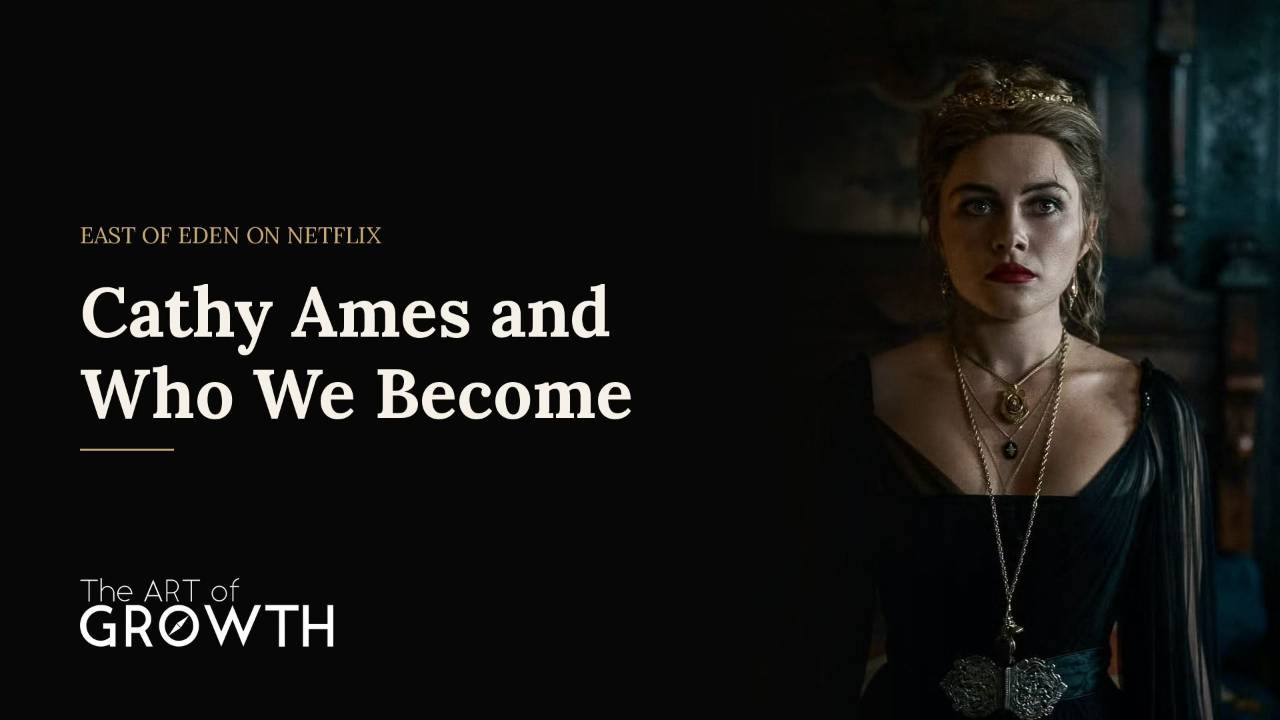
East of Eden and the Question of Who We Become
Why the new Netflix adaptation made me think about personality, trauma, and the choices that shape our lives.
Spoiler warning: This article discusses the ending of Netflix's 2026 adaptation of East of Eden.
John Steinbeck's East of Eden is one of my favorite books of all time. One of the things I love about it is how deeply it wrestles with human nature. Why are we the way we are? How much of who we become is already inside us when we're born? How much is shaped by the things that happen to us? And how much freedom do we actually have to choose the kind of person we become?
These are questions I've spent the last decade exploring through personality and the Enneagram. They're also questions that sit at the heart of East of Eden.
So I was excited to see Netflix's new adaptation, particularly with Florence Pugh playing Cathy Ames. There is a lot to appreciate about the series, but one particular decision bothered me. It wasn't just a change to a character's story. It seemed to change something fundamental about the psychological questions Steinbeck was exploring.
Are monsters born or made?
Early in the novel, Steinbeck introduces Cathy Ames with a provocative suggestion:
"I believe there are monsters born in the world to human parents."
He goes on to wonder whether someone might be born without the same capacity for kindness or conscience as other people.
Cathy is a fascinating character precisely because Steinbeck presents her as someone whose cruelty doesn't fit our usual explanations. She manipulates, deceives, exploits, and destroys people, often without displaying the internal conflict we would expect. Her behavior doesn't seem to emerge from a single terrible experience. It's a remarkably consistent part of who she is.
Steinbeck isn't necessarily offering a scientific theory of personality. He's exploring a disturbing possibility: What if some of the things we find most troubling about human behavior are rooted in the nature of the person themselves?
Interestingly, as the book progresses, Steinbeck even begins to question his own description of Cathy. He wonders whether calling her a monster was entirely fair or accurate. I love that tension. He isn't simply explaining her away.
The new Netflix series opens with a version of that same passage, spoken in Florence Pugh's voice. But by the end, the adaptation takes Cathy in a different direction.
We learn that something traumatic happened to her as a child. The implication is that this experience fundamentally changed her, setting in motion the cruelty and destruction that would follow.
The novel does include a disturbing childhood incident, but Steinbeck presents Cathy as the one in control. The series reinterprets that moment as something done to her, and makes it central to explaining who Cathy becomes.
And that's where I started to struggle with the adaptation.
Not because trauma doesn't matter. Of course it does. But because of how the series handles a question Steinbeck left open.
Steinbeck was primarily asking about her nature, and then he complicates his own question. At the end of the series, Cathy's dying moments lean toward an answer: that she became who she became because of what happened to her.
You could make the argument that thou mayest applies to her as well. But the series spends those moments on her childhood trauma, and it seems to offer that as the explanation. That's what I don't like.
On its own, that explanation is incomplete.
What psychology has learned since Steinbeck
Our understanding of psychology has come a long way since this book came out, and it has begun to explore the very question Steinbeck was asking. Is it possible that some people are born with substantially different capacities for empathy, guilt, or emotional connection?
The answer appears to be yes. Research into psychopathy and callous-unemotional traits suggests genetics play a meaningful role in these differences.
We've even begun hearing from people who identify with these traits. What's fascinating is hearing them describe how they've learned to navigate relationships and make deliberate choices about how they treat others.
And that brings us right back to Steinbeck.
Being born with a reduced capacity for empathy isn't the same as being born destined to harm people. Having a natural tendency toward manipulation or emotional detachment doesn't eliminate the possibility of choosing how to behave.
Of course, our ability to choose is itself influenced by our biology and experiences. But predisposition isn't predestination.
This is why I find Steinbeck's question so much more interesting than a simple explanation of Cathy through childhood trauma. He was willing to entertain the possibility that something about her was present from the beginning. But the larger moral question of the novel remains: What do we do with the nature and circumstances we've been given?
Core, Context, and Construct
Last week, we wrote about a framework we use at The Art of Growth to explain how identity forms. We call it Core, Context, and Construct.
Core (nature) is the foundation: our Enneagram type and innate tendencies. We don't arrive as blank slates. There is a genetic component, and it is highly influential. These inborn traits shape how we process the world, influencing our motivations, fears, and natural strengths. While Core remains stable, it does not exist in isolation.
Context (nurture) introduces external influences, shaping how our Core is expressed. Culture, family, socioeconomic background, and life experiences reinforce, challenge, or suppress certain aspects of our identity. Some people are given environments that cultivate their natural strengths, while others must adapt in response to hardship or limitation.
Construct (choice) is where identity becomes an active process. Through interpretation, we assign meaning to our experiences; through consciousness, we develop self-awareness; through choice, we take part in who we become.
Two people with the same Core and similar Contexts may develop entirely different identities based on how they frame their past and what they choose to pursue.
Construct is where we take responsibility and claim our agency.
All three matter, and they continually interact.
People often favor one explanation at the expense of the others. You hear it in everyday language: "People don't change." "You're a product of your environment." "Pull yourself up by your bootstraps." Each one sees something true, but each becomes reductionistic when it's treated as the whole story.
Our natural wiring is real, but it isn't destiny. Our experiences shape us, but they don't entirely define us. And our choices matter enormously, but we don't make them from a position of unlimited freedom, untouched by our nature or history.
Identity is both discovered and created.
What bothered me about Cathy
I don't think there's anything wrong with exploring Cathy's experiences or even imagining what might have happened to her as a child. In fact, I think understanding someone's experiences can help us develop compassion for people whose behavior we might otherwise dismiss.
But I think there's an important distinction between understanding the experiences that contributed to someone's behavior and making those experiences the explanation for everything that follows.
In last week's post, we put it this way: trauma does not form the personality, but it shapes the way the personality mechanism responds to stimulus. Even in the Enneagram world, a common theme is that childhood wounds lead to type. We disagree.
The danger is that we begin to see people almost exclusively through the lens of what happened to them.
And when we do that, something gets lost.
We lose sight of the fact that different people respond differently to similar experiences. We lose sight of the natural tendencies they brought into those experiences. And sometimes we lose sight of the choices they made along the way.
I'm not suggesting that people simply choose how trauma affects them. Trauma can profoundly alter someone's nervous system, perception of safety, and capacity to respond freely. Nor am I suggesting that someone who has experienced trauma bears responsibility for what happened to them.
But there's a difference between recognizing those realities and concluding that harmful behavior is an inevitable consequence of suffering.
The Cathy of Steinbeck's novel challenges us because she doesn't fit neatly into our preferred explanations. Her natural tendencies are troubling. Her experiences certainly matter. And her choices repeatedly reveal and reinforce the person she becomes.
I think that's a more challenging and ultimately more interesting picture of human nature.
And perhaps that's why the new ending bothered me. It seemed to resolve a question that Steinbeck had deliberately made uncomfortable.
Thou Mayest
One of the most profound ideas in East of Eden is captured in the Hebrew word timshel, which Steinbeck interprets as "thou mayest."
It's at the heart of the book's exploration of good and evil, inheritance, family patterns, and human freedom.
Steinbeck is wrestling with whether we are destined to repeat the patterns of those who came before us or whether we have the capacity to choose another way.
That's a powerful idea, and one that connects directly to how I think about personality.
We don't choose our natural wiring. We don't choose much of the environment into which we're born. And we certainly don't choose many of the experiences that leave their marks on us.
But within the limitations of those realities, there is still the possibility of choice.
Not unlimited choice. Not the ability to become absolutely anything we imagine. But the capacity to recognize our tendencies, understand our patterns, and begin participating more intentionally in who we are becoming.
One of the things I love about the Enneagram is that it helps us recognize the patterns that have been operating in us, often without our awareness. Those patterns may have served us well in some situations and caused considerable damage in others.
Understanding them doesn't mean they suddenly disappear. But awareness can create opportunities to respond differently.
And each time we respond differently, we participate in constructing something new.
Perhaps the greatest tragedy isn't that we have destructive patterns. It's that we might never recognize that we have choices about how we respond to them.
We are more complicated than our explanations
I understand why modern storytelling often gravitates toward trauma as an explanation for destructive behavior. We've learned a great deal about how profoundly experiences can shape people, and that's an important development.
But I worry when our growing understanding of trauma leads us to treat it as the primary explanation for everything about a person.
It's possible to have compassion for someone's suffering without reducing their entire identity to that suffering. It's possible to recognize someone's natural tendencies without assuming they're incapable of change. And it's possible to believe in personal responsibility without pretending that everyone begins life with the same capacities, resources, or opportunities.
This is what I find so compelling about the intersection of Core, Context, and Construct. It requires us to hold multiple truths at once, even when doing so is uncomfortable.
I don't know whether Steinbeck intended Cathy to represent someone who was simply born evil. His own reflections throughout the novel suggest the question was more complicated than that.
But I appreciate that he was willing to leave us wrestling with it.
And while the new adaptation does preserve much of the novel's exploration of choice, I think its treatment of Cathy leans too heavily toward explaining her through what happened to her rather than leaving us to wrestle with the relationship between her nature, experiences, and decisions.
For me, that tension is what makes East of Eden so profound.
We are not simply the people we were born to be. We are not merely the sum of the things that have happened to us. And we are not entirely self-made.
We are some complicated combination of all three.
And perhaps the most hopeful part of that reality is that, even though we cannot choose everything about who we are, we can still participate in who we become.
Timshel- Thou mayest.