
Where Does Personality Come From? Nature, Nurture, or Choice?
Oct 14, 2026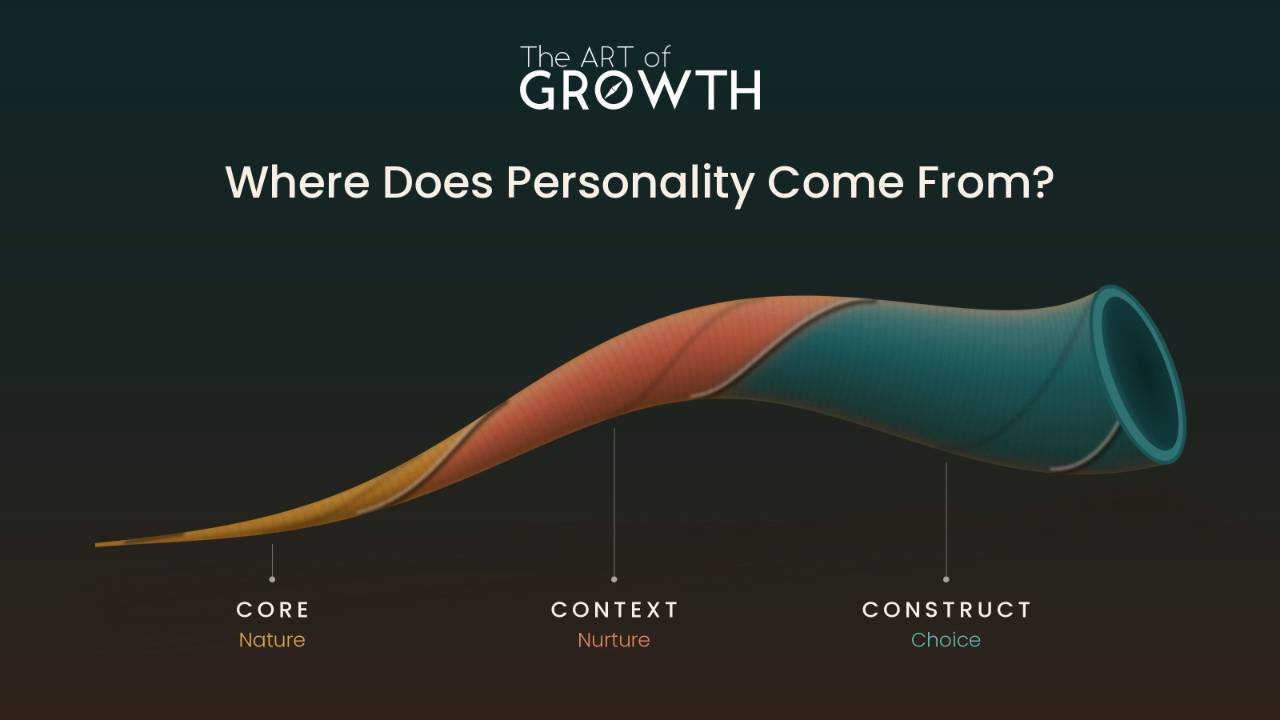
Identity Formation and Creation:
Core → Context → Construct
Almost everyone has heard it, or said it. "People don't change." "You're a product of your environment." "Pull yourself up by your bootstraps."
People have wondered for a long time how we became the people we became. There are three main ways people think about it: we were born this way, we were shaped by what happened to us, or we made ourselves. Each of those sayings comes from one of them.
By the end of this, we hope you'll see what we're advocating for: all three are huge. As you read, see if you can see yourself in each part.
Identity is both discovered and created, a dynamic interplay of innate traits, environmental influences, and personal choices. The Core → Context → Construct model explains how these forces work together to shape who we become.
Core (nature) is the foundation: our Enneagram type and innate tendencies. These inborn traits shape how we process the world, influencing our motivations, fears, and natural strengths. While Core remains stable, it does not exist in isolation.
Context (nurture) introduces external influences, shaping how our Core is expressed. Culture, family, socioeconomic background, and life experiences reinforce, challenge, or suppress certain aspects of our identity. Some people are given environments that cultivate their natural strengths, while others must adapt in response to hardship or limitation.
Construct (choice) is where identity becomes an active process. Through interpretation, we assign meaning to our experiences; through consciousness, we develop self-awareness; through choice, we take part in who we become. Two people with the same Core and similar Contexts may develop entirely different identities based on how they frame their past and what they choose to pursue.
Some perspectives overemphasize one component, believing identity is either innate, shaped entirely by environment, or solely a matter of personal will. This matters beyond theory. Every approach to healing has a theory of what the problem is, and if that theory names only part of the problem, the method will only be partly helpful.
True self-understanding requires integrating all three. We are born with a Core, shaped by Context, and active in the Construct we build. Identity is both something we inherit and something we create: a lifelong process of becoming.
This model breaks identity formation into three interdependent components.
1. Core (Nature)
The Core represents the foundational mechanisms we are born with: the motivations and cognitive-emotional tendencies that influence how we navigate life. These are predispositions, or tools, likely passed on from our ancestors.
There is good data that we are naturally predisposed to direct our attention and energy in certain ways. Anyone with multiple kids will tell you they seem to come into this world with at least some of their personality intact, and that something about them stays consistent even as they move through different parts of life. Research backs this up. A large 2015 meta-analysis of behavior genetic studies found that about 40% of the differences in personality between people are tied to genetics, with the rest tied to environmental influences. The book NINE Sapiens: Biology & Evolution of Personality Types takes this further, connecting genetic and evolutionary research to the nine Enneagram types.
Where this happens in the brain is still a best guess. One current idea is that it's tied to the reticular activating system (RAS), the part of the brain that cues us into what to pay attention to because it's important for getting our needs met.
- Enneagram Type: The internal motivation system that influences how a person perceives the world and seeks security, significance, and belonging.
What about the instincts? We don't know for sure yet, research-wise, whether our instinctual bias is Core. It looks like there is a natural way we are wired with a stack, but it's easy to mistake a season of development or a stage of life for that wiring.
The Core is the stable foundation of who we are, but its expression is shaped by external influences.
"You Are Who You Are" (Innate Identity & Determinism)
Those who emphasize Core believe that identity is fixed and largely determined by genetics, biology, or innate personality. This perspective downplays the role of external influences or personal choices, suggesting that we have little agency over who we become.
Philosophies & Beliefs
- Genetic Determinism: The belief that DNA and inherited traits determine intelligence, personality, and behavior. "It's all in your genes."
- Psychological Essentialism: The idea that people have a fixed nature that remains unchanged. "A leopard can't change its spots."
- Fatalism & Predestination: The belief that life's path is already set and cannot be altered. Found in some religious teachings (e.g., Calvinism's predestination doctrine). "Everything happens for a reason."
- Trait and Temperament Theory: Personality is made up of relatively stable traits (such as the Big Five) and an inborn style that shows up very young.
- Biological Theories: Personality is rooted partly in physiology, nervous system disposition, and brain-based tendencies.
Common Expressions
- "You can't teach an old dog new tricks."
- "It's in their nature."
- "People don't change."
- "The apple doesn't fall far from the tree."
Where this falls short: There is something real here. People do come into the world different. But when Core becomes the whole explanation, it leads to fixedness. Some people take responsibility for being who they are, in the sense that they do not blame anyone else, but that doesn't necessarily mean they do anything about it. Ownership without blame is not the same as transformation.
Spiritual Bypassing: Faith communities can lean toward this view too. Spiritual bypassing is the tendency to use spiritual ideas, practices, or beliefs to avoid, suppress, or sidestep unresolved emotional issues, psychological wounds, and real-world problems. It bypasses development and choice by believing things are part of God's will, whether we understand them or not, so we just need to have faith and trust. This sidesteps personal responsibility beyond personal morality. It also denies understanding or engaging with others who are hurting.
2. Context (Nurture)
The Context determines how a person's Core is shaped, reinforced, challenged, or suppressed. It includes three major components:
A. Overall Culture: The broad societal framework a person is born into.
- National, regional, or ethnic culture
- Historical, political, and religious influences
- Dominant values, traditions, and expectations
B. Subculture: The closer-knit social and familial environment.
- Family structure and dynamics
- Socioeconomic status
- Education and peer groups
- Access to resources and opportunities
- Stability vs. instability (financial, emotional, physical)
C. Personal Experience: The unique events and personal messages that shape self-perception.
- Key life events (trauma, achievements, failures)
- Experiences of acceptance or rejection
- Personal injuries, health challenges, or disabilities
- Messages received about identity, worth, and potential
Context influences how the Core is expressed, shaping beliefs, behaviors, and identity formation over time. It also adds layers and adaptations. Once the environment affects early development, the psyche uses whatever tools it has at its disposal to protect itself from pain. Beliefs form around that pain, along with biases that then seek confirmation.
This is why the distinction on trauma matters. Trauma does not form the personality, but it shapes the way the personality mechanism responds to stimulus.
"You Are a Product of Your Environment" (Social & Cultural Determinism)
This perspective argues that who you are is largely determined by where you were born, how you were raised, and the opportunities (or lack thereof) given to you. This view sees external factors as the dominant force shaping identity, often dismissing the idea of innate traits or free will.
Philosophies & Beliefs
- Behaviorism (B.F. Skinner, John Watson): The idea that human behavior is entirely shaped by conditioning and social reinforcement. "Give me a dozen healthy infants… and I'll guarantee to take any one at random and train him to become any type of specialist I might select." (John Watson)
- Social Learning Theory: We learn patterns by imitating and modeling the people around us.
- Psychodynamic, Object Relations, and Attachment Theory: Early relationships, especially with caregivers, shape the patterns we carry into adulthood.
- Trauma & Upbringing Models: The belief that childhood experiences shape everything about a person. "Your childhood defines who you are."
- Marxism & Economic Determinism: The belief that economic and social class structures shape a person's worldview and opportunities. "It is not the consciousness of men that determines their being, but their social being that determines their consciousness." (Karl Marx)
- Social Constructivism: The belief that identity is entirely built through cultural and societal influences. "We are nothing more than what society makes us."
Common Expressions
- "You are a product of your environment."
- "It takes a village to raise a child."
- "Tell me who your friends are, and I'll tell you who you are."
- "You can't escape your past."
Where this falls short: This is probably the most popular view in our time. These views name something real. People are shaped, beliefs form around pain, and adaptations become patterns. But when Context becomes the whole explanation, a person is reduced to what happened to them.
Even in the Enneagram world, a common theme is that childhood wounds lead to type. We disagree. We are also born with incredible gifts. Everyone's environment has things that happen to them and things that happen for them.
In much of modern culture, these explanations are often used as excuses that keep people stuck in a pattern, because they don't acknowledge the truth of the next element: what we construct. Healing the past can be necessary work, but by itself it is explanation without transformation.
3. Construct (Choice)
The Construct is the process through which we interpret experiences, develop self-awareness, and make choices that shape our evolving identity. It consists of three interdependent elements:
A. Interpretation: The meaning we assign to our experiences.
- How we frame life events (victim, villain, hero narrative)
- Internalized stories about ourselves and the world
- Personal beliefs, cognitive biases, and emotional filters
B. Consciousness: The level of awareness we develop over time.
- Our ability to see beyond automatic responses
- Reflection, self-awareness, and perspective-taking
- Emotional intelligence and cognitive flexibility
C. Choice: The active role we take in shaping who we become.
- Deciding which narratives to accept or rewrite
- Aligning actions with values and aspirations
- Exercising personal agency despite external influences
Construct is the bridge between Core and Context. It is how we respond to circumstances, make sense of our experiences, and shape our path forward. Through these choices, we can heal patterns and transform them into growth, or solidify them and harden them.
"You Make Yourself" (Personal Agency & Free Will)
This perspective sees identity as something that is built through intentional decision-making, self-awareness, and personal effort. It downplays genetics and environment, instead emphasizing the power of choice, self-improvement, and personal willpower. We are learning and adapting creatures, and this aspect can't be ignored.
Philosophies & Beliefs
- Existentialism (Jean-Paul Sartre, Nietzsche): The belief that individuals create their own meaning and identity through their actions. "Man is nothing else but what he makes of himself." (Jean-Paul Sartre)
- Humanistic Psychology: Emphasizes growth, authenticity, and self-actualization.
- Cognitive Approaches: Reframing beliefs, changing thought patterns, and choosing different responses.
- Coaching and Solution-Focused Approaches: Focus on where a person wants to go more than why they got here.
- Self-Help & Growth Mindset (Carol Dweck, Tony Robbins): The idea that people can change themselves through effort and mindset. "Whether you think you can, or you think you can't, you're right." (often attributed to Henry Ford)
- Rugged Individualism (Ayn Rand, Libertarianism): The belief that people succeed or fail based solely on their own choices. "The question isn't who is going to let me; it's who is going to stop me." (commonly attributed to Ayn Rand)
- Stoicism (Marcus Aurelius, Epictetus): The belief that external events don't matter as much as how we interpret and respond to them. "You have power over your mind, not outside events. Realize this, and you will find strength." (popular paraphrase of Marcus Aurelius)
Common Expressions
- "Pull yourself up by your bootstraps."
- "You are the architect of your own destiny."
- "If it is to be, it's up to me."
- "Don't let your past define you."
Where this falls short: Choice matters immensely. But when Construct is isolated from Core and Context, a person is pressured toward change without a full account of what they are working through. Healing becomes moralistic, performative, or prematurely future-focused.
This view can also be dismissive of the experiences others have, or of the very real limitations they face because of the way they are wired, what has happened to them, or trauma. It can lack empathy in explaining where people are.
The Same Problem in Every Arena
This is not only a question for personality theory. It shows up wherever people try to help.
- In therapy, someone may focus almost entirely on the past and on wounds.
- In coaching, someone may focus almost entirely on action and the future.
- In spiritual settings, healing may be framed in ways that bypass pain, conditioning, or deeper adaptation. In some spiritual or spiritual-like settings, it can also be controlling: the leader is assumed to know best, and agency is removed from others.
- In medicine, much of the field focuses on healing the body without addressing the psychological or emotional issues contributing to the physiology.
A partial model of the person creates a partial method of healing.
Putting It Together
Core, Context, and Construct are all huge. Who we are is something we discover and something we create. Each one asks something different of us.
Core: develop awareness. We didn't choose how we're wired. But we can learn how our attention and energy naturally move, and what motivates us underneath our behavior. The work here is awareness, not trying to become someone else.
Context: understand it, and shift what we can. We can't change what has already happened. We can understand how it shaped us, both what happened to us and what happened for us. And some of what shapes us is still happening: the people we spend time with, the places we work, what we take in each day. Some of those we can change.
Construct: this is where most of our agency is. It's the choices we make right now, with the wiring we have and the history we carry. Those choices can heal our patterns and turn them into growth, or harden them.
Healing the past matters. But building a new future is part of healing the past. Integration means understanding who we are and what formed us, and using that to build a life we're proud to live in. A life we take responsibility for in the present.
The North Star
So what are we building toward?
We don't look at people through the lens of pathology or morality. We don't see types as healthy or unhealthy. All of us have parts of our lives where we're doing well and parts that are less healthy. And on any given day, we're pulled toward a more reactive state or a more integrated one.
Every type carries a gift. We call it the North Star. It helps us navigate the world, belong to a community, and add meaning to our lives and the lives of others. Every type also has a low side that sabotages that gift.
Growth, then, isn't mainly about fixing what's wrong with us. It's about recognizing our gift and choosing it, again and again. When we do, we value ourselves and value others. We celebrate who we are, appreciate who others are, and relate well.
None of this denies pain, adaptation, or responsibility. It refuses to reduce anyone to one of them.
What are you constructing right now?