
How the Instincts Work Like the Enneagram Centers of Intelligence
Sep 15, 2026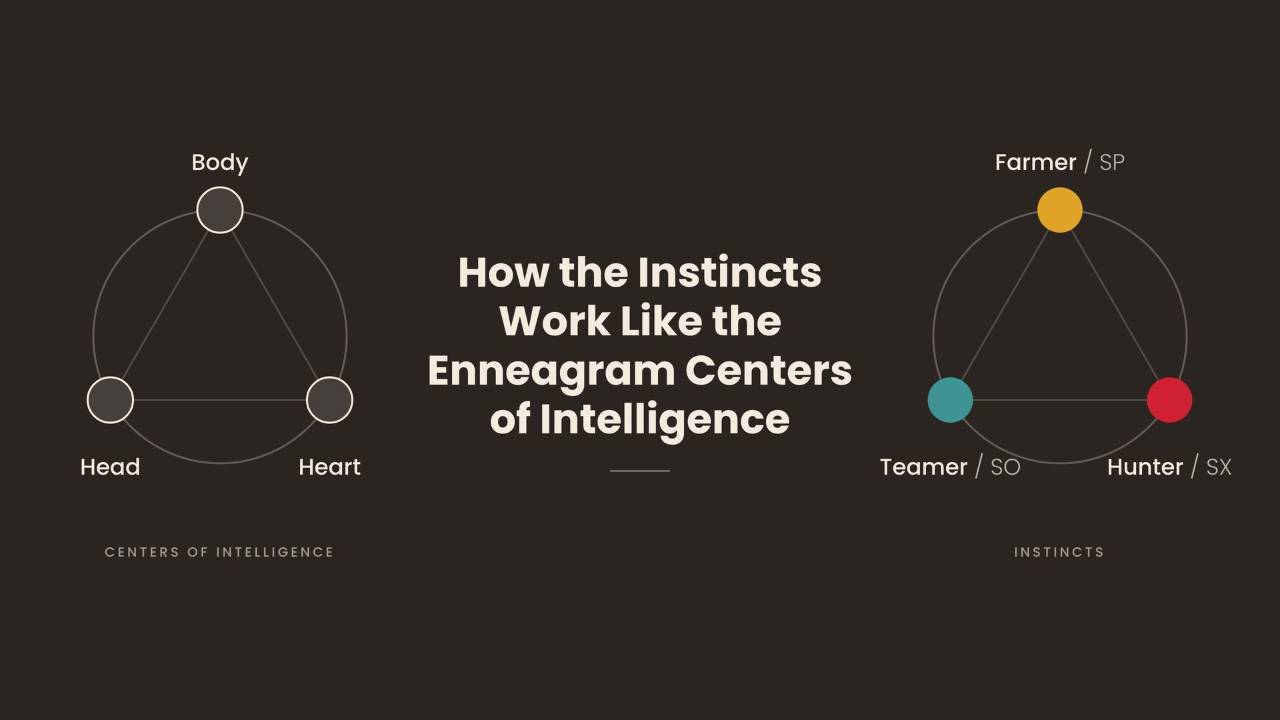
There is a long, deep, and well-understood tradition in the Enneagram around how the three centers of intelligence function and interact. Anyone who has spent time with the Enneagram knows the basic shape: we lead with one center, lean on a second, and under-use a third.
What we have learned in our work is that the instincts function in a very similar way. That makes sense. And seeing the two side by side may help us understand both of them better.
The centers and the instincts work the same way. Each one is good for you. Leave one out and you go deficient. Live off of one and it starts to show on the outside. We need all three.
If you are newer to the Enneagram, we will cover the basics of each system as we go.
The Tradition of the Centers
In the Enneagram, the nine types are grouped into three centers of intelligence: the Head Center, the Heart Center, and the Body Center. These are sometimes also called the thinking, feeling, and instinctive centers. Types 8, 9, and 1 are in the Body Center. Types 2, 3, and 4 are in the Heart Center. Types 5, 6, and 7 are in the Head Center.
The roots of this idea go back before the modern Enneagram of personality. George Gurdjieff taught about different human centers, including intellectual, emotional, and moving-instinctive centers. Later, Oscar Ichazo connected the Enneagram symbol with nine personality patterns, and Claudio Naranjo helped bring that work into modern psychological language in the United States.
So when we talk about the three centers, we are not just talking about personality types. We are talking about three basic ways human beings take in reality, process what is happening, and respond.
Each center has a function.
Head thinks. Heart connects. Body acts.
Or said another way:
- Body is Resolve: the source of action, boundaries, protection, and completion.
- Heart is Desire: the source of connection, passion, meaning, and empathy.
- Head is Process: the source of planning, understanding, perspective, and innovation.
The tradition also describes how the three interact. Each type leads with one center. A second center is used often, in support of the dominant. The third is often called the repressed center (the one we reach for least), and much of the growth work in the Enneagram involves bringing it back into relationship with the other two.
In our certification training, we put it this way: the problem isn't that there is a dominant center. The problem is that the dominant stops listening to the other two. It puts one to work for its own agenda and neglects or represses the other. This is all part of how the personality works to ensure its own survival.
In other words, the problem is not that we think, feel, or act. The problem is when one or two are used at the expense of the third.
The Instincts Work the Same Way
Most of us learned the instincts as self-preservation, sexual (one-to-one), and social, and we learned to think of them as a stack: a dominant instinct, a secondary, and a blind spot. We still use those terms (SP, SX, and SO) in one-on-one coaching, when we are talking with someone about their individual life and relationships. When we talk about how the instincts show up in our outward interaction and our contribution to the wider world, we use the terms Farmer, Hunter, and Teamer.
The instincts are the core drives underneath how we live and work. Every family, every community, every business, and every civilization came out of these three drives working together. You can see them all through the animal kingdom, and in us they took human beings from the first fire to the modern skyscraper. They are not personalities or types. They are primal forces wired into every one of us, and all of us carry all three.
- Hunter (sexual) is the instinct of pursuit and forward motion.
- Farmer (self-preservation) is the instinct of stability and sustainability.
- Teamer (social) is the instinct of connection and coordination across the whole.
Hunters create movement. Farmers build foundations. Teamers see how the parts connect.
What we have noticed is that the three positions in the instinct stack behave like the three centers.
| Centers of intelligence | Instincts | |
|---|---|---|
| First | The dominant center: home base, the one we lead with | The dominant instinct: sets the direction and brings our most rewarding contribution |
| Second | Used often, in support of the dominant | Creates the environment for the dominant and becomes our fallback under stress |
| Third | The repressed center: reached for least | The blind spot: felt more by its absence than its presence |
Our dominant instinct is where energy comes back to us. When we put effort there, it tends to return, with a sense that something meaningful is happening. Our secondary instinct shapes how the dominant is expressed and supports it day to day. When the dominant is blocked, we fall back on the secondary. That fallback can feel like still doing the right thing, but it often lacks the same reward.
Our tertiary instinct is the least natural and costs the most energy. Completing something there brings relief rather than reward. Still, it cannot be ignored. Without baseline competency in the tertiary, it undermines what the dominant wants most.
The same thing happens here. The dominant instinct puts the secondary to work for its own agenda, and the third drops out of the conversation. In both systems, things become problematic when we overuse one or two at the expense of the third. And in both systems, a lot of integration comes from including the third.
For practitioners, this may be the most useful part. If you already know how to help someone work with their repressed center, you already have a feel for working with their blind-spot instinct. The questions are similar. What does this part of you offer? What happens when it is left out? What would it look like to let it back into the conversation?
Four Lenses
As we walk through the centers and the instincts, we want to look at four things:
- Function: what it is for.
- Overusing: what happens when it starts carrying too much.
- Not Included: what it costs us when it is unavailable or neglected.
- Integrating: what becomes available when it is working in relationship with the other two.
The Head Center
The Head Center helps us make sense of the world through observation, analysis, and planning. The question underneath it is, "What's the pattern here? What do I need to understand or prepare for?" When we trust it, it gives us clarity. With other people, it builds trust through competence: "Do you know what you're doing?"
Function: focused on thinking, planning, analyzing, making sense of things, pattern recognition, and rational intuition.
Overusing: can begin experiencing anxiety and a kind of unproductive thinking or spin, needing all the answers before acting, or relying on intellect to avoid emotional or embodied experience.
Not Included: when the Head Center is missing, we react immediately instead of running things through the process. We lose observation, perspective, and the room to step back and ask what else could be true.
Integrating: more access to observation, clarity, processing possibilities, and better solutions, able to hold paradox without rushing to solve and let curiosity lead when certainty is unavailable.
What this can look like: Overusing the Head Center can look like asking for one more round of analysis before making a call the team has been waiting on. Leaving it out can look like answering a tense email right away, before stepping back to consider what else might be going on.
The Heart Center
The Heart Center is about relational awareness: how we are being seen, how close or distant we feel, and whether we are emotionally attuned. It is also where we take in and project identity. The question underneath it is, "What is my identity in this space? What's my proximity to others? Are we aligned?" With other people, it builds trust through care: "Do you care about me?"
Function: focused on feelings/emotions, relationships, identity, meaning, connection, and the sense of proximity and distance between self and others.
Overusing: can begin experiencing shame or sadness that produces unproductive connection to self and others, over-accommodation, or over-identifying with external validation.
Not Included: when the Heart Center is missing, we lose access to desire, meaning, and connection: successful, maybe, but without a clear sense of why, and disconnected from ourselves and others.
Integrating: more access to relational dynamics, true desire, mission, and better connection with others, able to speak truth without losing relationship and stay emotionally present even when uncomfortable.
What this can look like: Overusing the Heart Center can look like saying yes to every request so no one is disappointed. Leaving it out can look like hitting every target and still not being able to say why the work matters.
The Body Center
The Body Center is where we take up space, feel our boundaries, and act in real time. It governs gut instinct, right timing, and presence under pressure. The question underneath it is, "What's the right action right now? Am I present? Am I in alignment with myself?" With other people, it builds trust through character: "Can I count on you to follow through?"
Function: focused on action, instinct, boundaries, presence, protection, and a somatic sense of right and wrong.
Overusing: acting without process or consideration of others, reactive actions over intentional ones, and unproductive doing for the sake of doing.
Not Included: when the Body Center is missing, we lose groundedness, boundaries, and the ability to act on what we know. We get stuck trying to resolve through thought or feeling what only action can settle.
Integrating: more access to right action, justice/fairness, internal values, intuitive or somatic yes and no, gut sense of what to do, and the ability to stay grounded in feedback or tension.
What this can look like: Overusing the Body Center can look like jumping into action on a problem before anyone has agreed on what the problem is. Leaving it out can look like knowing a hard conversation needs to happen and talking about it for weeks instead of having it.
The Hunter
The Hunter is the part of us that looks out at what could be different and feels the pull to go after it. When there is a possibility in front of us, a challenge worth taking on, or a chance that isn't ours yet, this is the part that leans toward it and says, let's go get it. It also turns up when things have gone stale and we look around and think, there has to be more than this.
Function: focused on pursuit, change, and opportunity: noticing what is possible and where momentum can be created, learning by stepping directly into the challenge, and wanting our effort to make an impact that moves something forward.
Overusing: chasing momentum at the expense of the whole system. We can generate excitement and change, but the gains are not kept. There is an initial surge without buy-in, and the momentum fragments and runs out.
Not Included: when the Hunter is missing, the system closes. Little new comes in, so energy, ideas, and relationships slow and grind down. We miss openings, find it harder to put ourselves forward, and adapt late instead of naming where things should go next. People can feel safe and included but not personally seen. Motion gives way to maintenance, and consensus can replace courage.
Integrating: allowing some excitement and forward energy into the system on purpose. Small, steady risks reopen the system, and a little anxiety can turn into energy for engagement. With some Hunter in play, the Teamer regains direction and the Farmer avoids stagnation.
What this can look like: Overusing the Hunter can look like a launch that starts strong and then stalls, because no one else was brought along and nothing was put in place to hold it. Leaving it out can look like slow adaptation, red tape instead of renewal, and a pattern of reacting late to change.
The Farmer
The Farmer is the part of us that wants steady ground under our feet, a rhythm we can count on, and enough security to work with intention. When there is a life to build, something worth protecting, or work that has to hold up over time, this is the part that says, let's make this solid, let's make sure it lasts. It is the first of these instincts we ever know. We come into the world needing warmth, food, and safety.
Function: focused on stability, structure, and sustainability: noticing what can be sustained over time, building the systems and rhythms that make good work repeatable, and managing time, energy, money, information, and capacity with care.
Overusing: managing the plan at the expense of the larger opportunity. The pull of routine can be so strong that needed change is resisted, and stability turns into stagnation. We maintain but do not multiply. Structure gets preserved while the people it is supposed to serve get undercut.
Not Included: when the Farmer is missing, life loses its rhythm and stability. Tasks get rushed or skipped, shortcuts create the same problems again later, and rest erodes. What we build does not last, because the environment that sustains it is not being maintained.
Integrating: enough grounding for everything else to hold. The Farmer steadies the Hunter and gives progress and connection a place to take root. Integration begins when we let the slow work of the Farmer support the fast energy of life.
What this can look like: Overusing the Farmer can look like following a plan so closely that an opening passes by. Leaving it out can look like the same issue coming back every quarter because no one built the process to solve it once.
The Teamer
The Teamer is the part of us that focuses on the larger network of relationships around us. It wants to be part of something bigger than ourselves, to figure out where we fit, and to contribute to the whole while being resourced by it in return. It turns up when people are drifting apart or working in silos and we look around and think, we're not moving together on this.
Function: focused on connection, contribution, and coordination across the whole system: seeing how people, teams, decisions, and handoffs affect one another, helping people access and support each other, and aligning individual strengths toward shared goals.
Overusing: holding the whole at the expense of clear parts, priorities, and ownership. It becomes hard to stop serving others. We are with people constantly without tending to our own restoration, and over time energy tightens and patience fades.
Not Included: when the Teamer is missing, collaboration breaks down. People work around each other instead of with each other. It is harder to read the room or see how one decision affects the rest of the system. Efforts get duplicated, roles collide, and processes may run while morale declines. We might still get results, with less alignment, less buy-in, and less of the "we" that makes work sustainable.
Integrating: a habitual pause to ask, "How does this affect the whole?" We widen our view before acting, build small connection rituals, and invite voices that see what we don't. The Teamer connects the Hunter and the Farmer to a larger purpose.
What this can look like: Overusing the Teamer can look like every decision waiting until everyone is aligned, with no one clear on who owns what. Leaving it out can look like silos, workarounds, and two teams solving the same problem without knowing it.
Integration Comes From All Three
We are not looking for balance. We are looking for harmony, like a musical chord. There is a root note, which is our dominant. A second note supports it. But the third is what makes it a full chord.
This is true of the centers. To accomplish anything, we need the head, the heart, and the body. Yet most of what we hear from motivational speakers and experts advocates for one. Many talk about finding your heart's desire. Many talk about beginning with the end in mind and making a plan. Others talk about will, discipline, and resolve. These are inextricably linked, or they do not happen at all. The heart may want what it wants, but it doesn't always know why, how to get there, or how to sustain the effort it takes.
It is true of the instincts too. Pursuit, stability, and connection each depend on the other two.
One way to check is to ask a few questions. For the centers: What do I want? How will I get there? What will I do? For the instincts: What opportunity am I not seeing? What needs to be in place for this to last? How does this affect the whole? The question that is hardest to answer often points to the one we have been leaving out.
Keep Learning
If you want to go further with the centers and the instincts, here is where to start.
- Free Instinct Stack Test: instinctstack.com
- Instincts Class: Working From Your Natural Energies: Instinct Stacks: The Ultimate Guide, Part 1
- Enneagram Class: Your Enneagram Starting Point
- Book: Hunters, Farmers, and Teamers