
How an Enneagram Type Works
Sep 28, 2026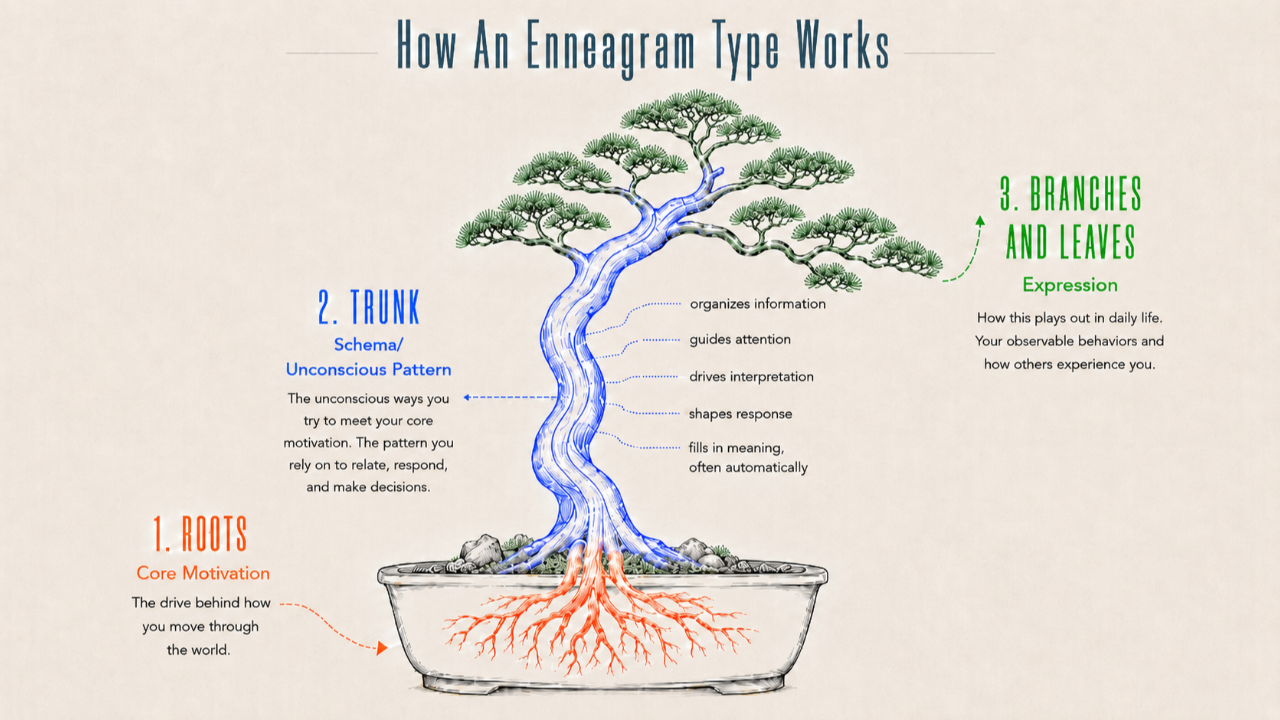
Take a free assessment HERE.
What we mean when we say "type"
Type means more than a number.
It is easy to blur the two words. We name the nine core patterns Type One through Type Nine, so in everyday use, "type" and "number" come out sounding like the same thing. When we say "Type Four" or "Type Eight," we are usually just naming the number. But the number is only one part of your type.
Your type, in the way we use the word, is one of the nine Enneagram numbers moving through one of six possible instinctual stacks, the way your three instincts are ordered. That makes fifty-four possible combinations, which is part of why two people who share the same number can still look so different from each other.
So when we say type, we mean this whole combination and not the number by itself: your core motivation, the unconscious pattern it produces, and the expression others see, with your instincts woven through all of it.
To see how it works, it helps to start with how the mind organizes experience.
Psychology uses a word called schema. A schema is an unconscious pattern, a mental framework that helps you interpret, process, and respond to information.
A schema organizes information, helping you make sense of what is happening. It guides attention, influencing what you notice and what you ignore. It drives interpretation, filling in meaning, often automatically. And it shapes response, informing how you react, relate, decide, and behave. Most of this happens before you even realize it is happening.
That is where the Enneagram is useful.
The Enneagram gives us a model for seeing the nine core types that shape how people move through the world. Each type represents a distinct pattern, a specific way of organizing experience, directing attention, making meaning, and generating a response.
At the center of each type is a core motivation. That motivation produces a consistent unconscious pattern. And that pattern produces what others eventually see on the outside: your expression.
So a "type" has three connected parts:
- Core Motivation: the drive behind what you pursue and avoid.
- Unconscious Pattern: the ways you try to meet that core motivation. The pattern you rely on to relate, respond, and make decisions.
- Expression: how you show up in the real world, shaped by your instinctual stack, environment, and personal experience.
Or more simply:
Core motivation is why you do what you do. Unconscious pattern is what you do to meet the core need. Expression is how it tends to look on the outside.
Why this distinction matters
So many people get stuck at the level of behavior. They ask, "Do I act like a Type One?" "Do I seem like a Type Seven?" "Do I look like a Type Nine?" But the Enneagram has never been most powerful when it describes what you look like from the outside. It is most powerful when it helps you understand what is happening underneath. Your Enneagram number is a self reported resonance to a core motivation and pattern of one of the 9.
Why does your attention keep going there? Why do certain things feel threatening while other people barely notice them? Why do you respond the way you do before you even have time to think?
That is the deeper work. That is where we practice.
From self-awareness to compassion
The deeper work is not just about understanding yourself in isolation. The more aware you become of your own patterns, the more freedom you have in your relationships. The more you understand your own reactions, the less you are ruled by them. The more clearly you see what drives you, the more compassion you can have for what drives someone else.
This is why we keep coming back to the Enneagram, not because it gives us nine boxes, but because it gives us a way to notice what is normally hidden.
Type and instinct cannot be separated
As we have continued this work, especially through the lens of the instincts, we have become more convinced that type and instinct cannot really be separated. We would go as far as saying it is 50% type and 50% instinct. Your type does not express itself in some generic form. It moves through your instinctual stack and through your real life: your story, your culture, your relationships, your work, your wounds, and your gifts.
This is part of what we keep exploring, especially as we record a panel for every combination: more questions, more data, more stories, more nuance, and clearer language.
Learn with us. Question with us. Test the model with us. And keep doing the work of seeing yourself more clearly, not just for your own sake, but for the sake of the people you love, lead, serve, teach, work beside, and walk through life with.
Because self-awareness is never meant to end with the self. It is meant to help us become more present, more honest, more compassionate, and more free.