
The Three Centers: Function, Overuse, and Integration
Sep 10, 2026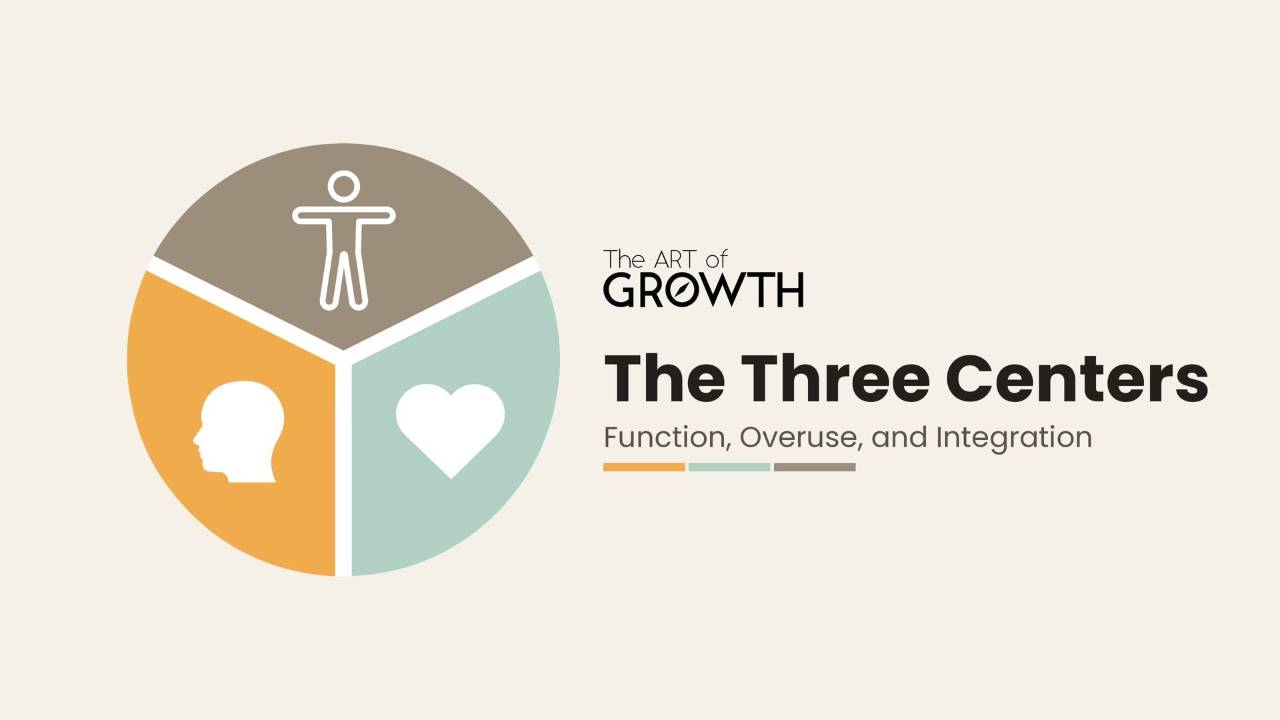
Every human being takes in reality in three ways.
We feel. We think. We act.
Most of us lean hard on one or two of these and let the third run quiet in the background. It works well enough, until the piece we have neglected is exactly what the moment calls for.
In the Enneagram, these three ways of engaging the world are grouped into three centers of intelligence: the Head Center, the Heart Center, and the Body Center. They are sometimes called the thinking, feeling, and instinctive centers. Each one has a function. Neglect one and you feel the lack. Rely on one and the cost begins to surface. Health is the mix.
The roots of this idea go back before the modern Enneagram of personality. George Gurdjieff taught about different human centers, including intellectual, emotional, and moving-instinctive centers. Later, Oscar Ichazo connected the Enneagram symbol with nine personality patterns, and Claudio Naranjo helped bring that work into modern psychological language in the United States.
So when we talk about the three centers, we are not only talking about personality types. We are talking about three basic ways human beings take in reality, process what is happening, and respond.
Each center has a function.
Head thinks. Heart connects. Body acts.
Or said another way:
- Body is Resolve: the source of action, boundaries, protection, and completion.
- Heart is Desire: the source of connection, passion, meaning, and empathy.
- Head is Process: the source of planning, understanding, perspective, and innovation.
The problem is not that we think, feel, or act. The problem is when one or two are used at the expense of the third.
As we walk through the centers, we will look at four things:
- Function: what the center is for.
- Overusing: what happens when that center starts carrying too much.
- When Underused: what it costs us when that center is unavailable or neglected.
- Integrating: what becomes available when that center is working in relationship with the others.
Head Center
Function: focused on thinking, planning, analyzing, making sense of things, pattern recognition, and rational intuition.
Overusing: can begin experiencing anxiety and a kind of unproductive thinking or spin, needing all the answers before acting, or relying on intellect to avoid emotional or embodied experience.
When Underused: when the Head Center is underutilized or ignored, we react immediately instead of running things through the process. We lose observation, perspective, and the room to step back and ask what else could be true.
Integrating: more access to observation, clarity, processing possibilities, and better solutions, able to hold paradox without rushing to solve and let curiosity lead when certainty is unavailable.
Heart Center
Function: focused on feelings/emotions, relationships, identity, meaning, connection, and the sense of proximity and distance between self and others.
Overusing: can begin experiencing shame or sadness that produces unproductive connection to self and others, over-accommodation, or over-identifying with external validation.
When Underused: when the Heart Center is underutilized or ignored, we lose access to desire, meaning, and connection. We may be successful, but without a clear sense of why, and disconnected from ourselves and others.
Integrating: more access to relational dynamics, true desire, mission, and better connection with others, able to speak truth without losing relationship and stay emotionally present even when uncomfortable.
Body Center
Function: focused on action, instinct, boundaries, presence, protection, and a somatic sense of right and wrong.
Overusing: can begin to experience increased anger and engage in unproductive activity simply for the sake of doing, becoming disconnected from physical needs and avoiding conflict in the process.
When Underused: when the Body Center is underutilized or ignored, we lose groundedness, boundaries, and the ability to act on what we know. We get stuck trying to resolve through thought or feeling what only action can settle.
Integrating: more access to right action, justice/fairness, internal values, intuitive or somatic yes and no, gut sense of what to do, and the ability to stay grounded in feedback or tension.
Bringing All Three to the Table
These days, when I want to move toward more integration, I picture myself sitting down at a table with all three centers. Whatever I am trying to navigate, I bring it to that table. I check in with all three, because I want to hear the wisdom of each one.
I want every center to bring its gift and function. I do not want any of them overused or dominating the conversation. And I do not want any of them silenced or ignored. So I invite all three to speak.
If you'd like some COACHING around that... BOOK IT!
Grace and Growth,
Jim Zartman