
Enneagram Instinctual Variants, the Purpose of Each, and How the Full Stack Works Together
Sep 07, 2026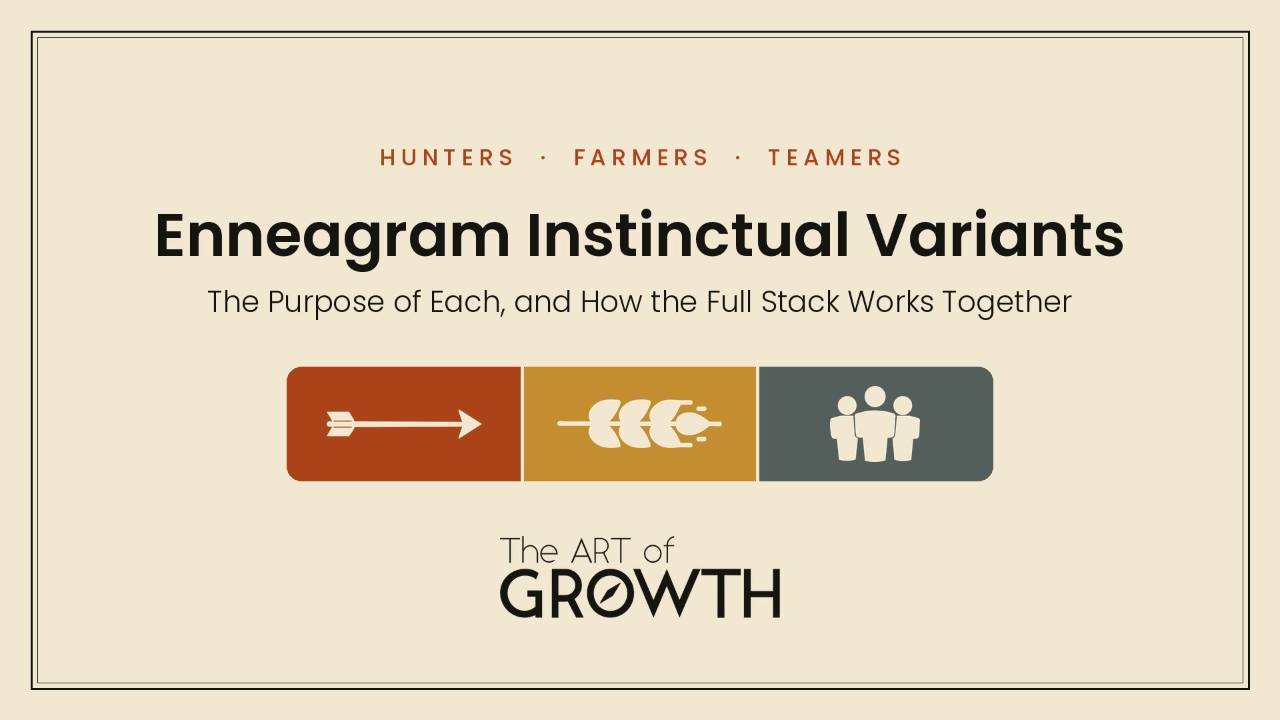
If you have not yet taken an instinct variant test, take ours here at www.instinctstack.com.
Many people first run into the instinctual variants through the Enneagram: self-preservation, social, and the one-to-one, or sexual, instinct. It is easy to treat them like a category to land in — "I'm a self-pres," "I'm a social" — and stop there.
That framing misses the point. You are not one instinct. All three live in you, all the time. Each one is doing a job, and you need all three to function well.
In the Hunters, Farmers, and Teamers framework, these same three instincts go by names that describe what they actually do:
- The Hunter is the sexual, or one-to-one, instinct.
- The Farmer is the self-preservation instinct.
- The Teamer is the social instinct.
Sexual, self-preservation, and social are the developmental-stage versions of the instincts; Hunter, Farmer, and Teamer are the terms for those same instincts once they mature and make their unique contributions.
The names matter because they point to purpose. The instincts are not personality boxes. They are drives, and each one exists to meet a real need. Once you understand what each is for, the label stops being the interesting part.
All three are always in you
Everyone carries all three instincts. What differs from person to person is not whether you have them, but how much each one leads. One tends to run out in front. One supports it. One lags behind. We will come back to that order, because it is where a lot of the practical value lives. First, it helps to see what each instinct is actually for.
The Hunter: keeping you from going stale
The Hunter is the part of all of us that keeps us from stagnating or going stale. It seeks change to make sure new resources are coming our way and new opportunities are available to meet our needs.
This is the drive that notices when something has run its course and starts looking for what is next. It goes after the opportunity, tries the new approach, and keeps you from settling into a version of things that used to work but no longer does. Without it, we hold on to the familiar long past the point where it serves us.
The Farmer: making things last
The Farmer is the instinct in all of us that knows we need some structure and stability to make things last over the long term. We need to manage resources well to make them last and grow.
This is the drive that builds the systems, keeps the routines, and protects what has already been gained. It turns a good idea into something that holds up over time. New resources are only useful if something keeps them from slipping away, and that is the Farmer's job.
The Teamer: staying connected to the whole
The Teamer is the part of us that understands we need to be connected to a wider community to accomplish anything significant, as well as to have our own needs of resources, connection, and safety met.
This is the drive that keeps you aware of the larger network of relationships that any real accomplishment depends on. It is worth being clear about what this is not: the Teamer is not the same as being outgoing or drawing energy from a crowd. It is attention to the whole — to who else is part of this, and whether the whole is working. Without it, we try to carry everything alone and lose the connection that makes significant things possible.
Why the variance matters
Here is where the "variant" part comes in. All three instincts are present in everyone, but they do not carry equal weight. They stack. One instinct leads, one supports, and one runs in the background.
- Your dominant instinct is the one that leads. It is where you gain energy as you use it, where you develop quickly, and where your contribution feels most natural and rewarding.
- Your secondary instinct supports the first. It is the environment you tend to create so your dominant instinct can do its best work, and it is the one you fall back on under stress.
- Your tertiary instinct runs last. You can build baseline competency there, but it costs energy, and finishing that kind of work brings relief rather than reward.
The purpose of each instinct does not change from person to person. The Hunter always keeps things from going stale. The Farmer always works to make things last. The Teamer always keeps you connected to the whole. What changes is how much each one leads in you — and that order shapes where you contribute easily, where you are comfortable, and where you have to spend extra energy.
Different order, same purpose
This is why "which instinct am I" is the wrong question. You are all three. The useful question is which order they run in, because that tells you where your natural gifts are, what kind of environment supports them, and what you are better off not trying to run your whole life from.
Understanding the purpose each instinct serves is the first step. Understanding your own order is the next one — and it is where this stops being theory and starts being something you can use.