
Enneagram Instincts Variant Test
Jun 27, 2023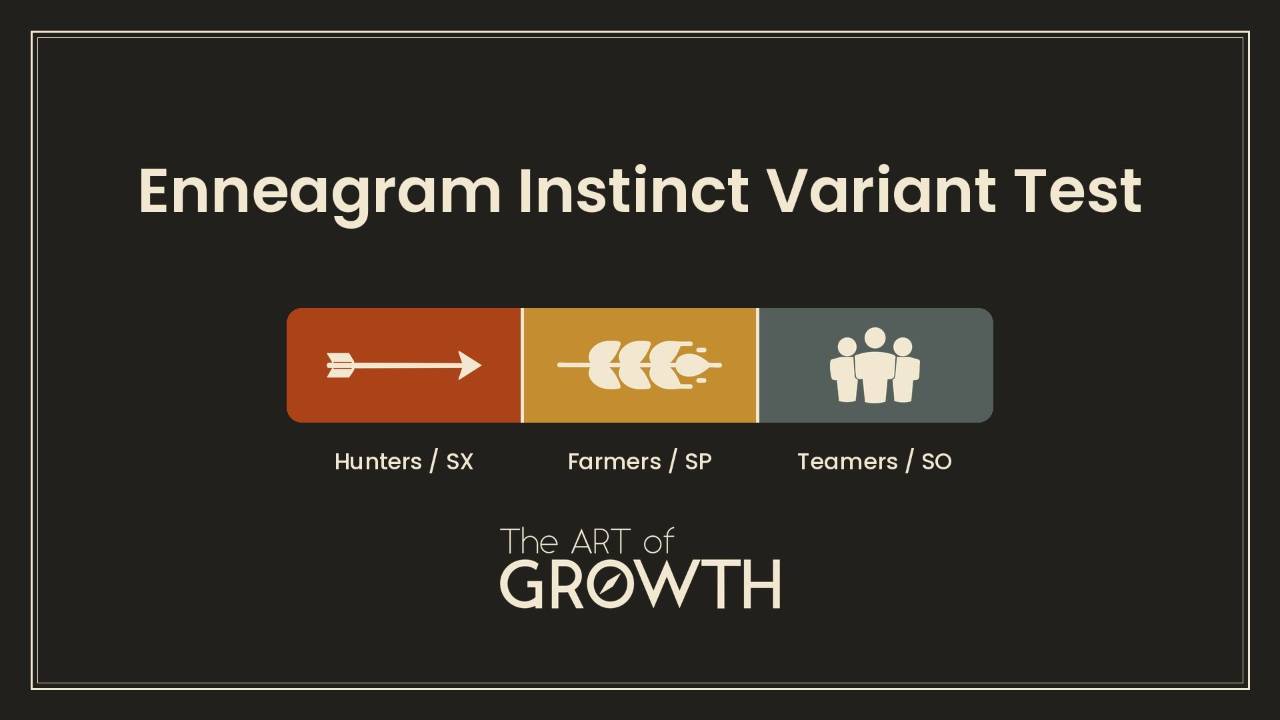
The Enneagram Instincts Variant Test: Find Your Instinct Stack
Long before you ever learned your Enneagram type, three instincts were already shaping how you live, lead, and relate. They are the primal drives underneath everything human beings build — families, teams, businesses, whole civilizations — and every one of us carries all three. What differs from person to person is the order they run in. We call that order your Instinct Stack, and coming to know it changes how you understand yourself at the root: where your energy actually comes from, what you are naturally built to be good at, and what quietly wears you down.
The Art of Growth — a coaching, training, and consulting firm — created a free assessment to help you find yours. You don't need to know your Enneagram type to benefit from it. The stack stands on its own. Best of all, it's free. [Find your stack at instinctstack.com.]
The three instincts, in plain language
Three instinctual drives sit underneath everything you do, and every human shares all three. These aren't personalities or boxes to sort people into — they're forces wired into us long before we had any say. In our work with organizations, we give them everyday names: Hunters, Farmers, and Teamers.
Hunters are the instinct of pursuit and forward motion. This is the part of you that looks at what could be different and feels the pull to go after it — to spot the opening, take on the challenge, and create movement. Hunters learn by stepping directly into the work, and they are driven by impact: they want their effort to matter and to move something forward. (Developmentally this is sometimes called the sexual/one-to-one instinct — the drive to take risks, explore, and pursue what is beyond us. As it matures into how we work and live, we call it the Hunter.)
Farmers are the instinct of stability and sustainability. This is the part of you that wants steady ground underfoot and enough security to work with intention — to build something solid and keep it running well. Farmers create the systems, rhythms, and resources that make good work repeatable, and they manage time, energy, and capacity with care. (Developmentally this is the self-preservation/preservation instinct — the drive to seek safety and stability and build the environments that protect us. As it matures, we call it the Farmer.)
Teamers are the instinct of connection and coordination. This is the part of you tuned to the larger web of relationships — where you fit, what you can contribute, and how the whole moves together. Teamers read what a group needs and flex to fill the gap, aligning people's strengths toward a shared goal. (Developmentally this is the social instinct — the drive to belong, connect, and build community. As it matures, we call it the Teamer.)
How does the Enneagram Instincts Variant Test work?
Have you ever wondered why you react the way you do under pressure, or why two people on the same team approach the same problem so differently? Your instincts are usually part of the answer — and the key is that you don't just have one. You carry all three, but they don't carry equal weight. Two tend to be active and developed. One is often felt more by its absence than its presence. That ordering is your stack, and it has three roles:
- Dominant — the gift you lead with. Your contribution feels most rewarding here, and you develop fastest in it. It sets your direction.
- Secondary — your strong support. It shapes how your dominant gift gets expressed, and it becomes your familiar fallback under stress when the dominant is blocked.
- Tertiary — your blind spot. It is the least natural and most costly, felt more by its absence than its presence. Leaning on it too long leads to burnout, yet ignored entirely it can quietly undermine the rest. The goal is not to make all three equal, only to keep this one in working order.
The nuance lives in the pairing of your top two. Two people can both lead with the Hunter and still work very differently: a Hunter who runs Farmer second finds the opening and immediately builds the plan and resources to make it real, while a Hunter who runs Teamer second finds the opening and instinctively brings people along. There are six of these stacks in all, each with its own strengths and blind spots — and the assessment shows you yours.
If you already know the Enneagram, your stack adds a rich layer to your type. If you don't, it stands entirely on its own. At work especially, people tend to experience each other's instincts more directly than their Enneagram number.
How can I take the Enneagram Instincts Variant Test?
Getting your stack takes only a few minutes, but a little intention makes the results far more useful:
- Take the free Instinct Stack assessment. You'll receive your three instincts in order — dominant, secondary, and tertiary. [Start at instinctstack.com.]
- Set aside uninterrupted time. The questions ask for honest self-reflection, so give yourself a few quiet minutes without distraction.
- Answer honestly, not aspirationally. Respond as you actually are, not as you'd like to be. The most helpful result is the true one.
- Read the whole stack, not just the top. Your dominant is the gift you lead with, but your secondary shapes how it shows up, and your tertiary is where both growth and burnout live. The relationship among all three is the real picture.
- Notice your natural energy. As you consider each instinct, note which one feels most natural and energizing and which takes the most effort. That contrast is the doorway to your stack.
- Go deeper with the Instincts Panel Series on The Art of Growth Podcast, where people of each stack describe their inner world in their own words.
What are the benefits of taking the Enneagram Instincts Variant Test?
Whether you're leading a team or simply trying to understand yourself, knowing your stack pays off in concrete ways:
- Sharper self-awareness, and faster growth. When you can see where your energy comes from, you can name what you are built to be good at — and where you will build skill the fastest, almost without trying. That tells you where to invest your effort so it actually returns to you, instead of spreading it evenly across strengths and struggles alike.
- Clearer communication. Understanding the instincts of the people around you helps you meet them where they are. A Teamer-led colleague responds to connection and shared purpose; a Hunter-led colleague responds to focus, challenge, and momentum; a Farmer-led colleague responds to structure and a plan that will hold.
- Stronger teamwork. Each instinct notices something the others can miss. Hunters spot the opening, Farmers protect the resources and capacity, and Teamers track how the whole system connects. When those instincts are named and respected, friction turns into complementary strength.
- Real growth without burnout. Your dominant is where you thrive; your tertiary is where you wear down if you overstay. Naming your stack tells you which strengths to lean into and which drive you only need to keep in working order, so you grow through what energizes you rather than grinding on what drains you.
- Smarter hiring and role assignment. The stack gives leaders a practical lens for matching work to wiring. In hiring, you can look past the résumé to whether a role fits how a person is actually built. In delegation, you can assign tasks to the instinct they draw on — pursuit and momentum to a Hunter, structure and follow-through to a Farmer, coordination and connection to a Teamer — so people spend more time in their gift and less time working against the grain.
Often, when we're stuck, it's because one instinct is being neglected. The question worth asking is: which one, and what would change if I brought it back in?
Ready to find yours? [Take the free Instinct Stack assessment at instinctstack.com.]
From there, you can go as deep as you like:
- Order the book for the full framework and how to put it to work in your life, your team, and your organization.
- Massachusetts Businesses - We can train your team through the Work Force Training Fund Grants! (National and international brands- contact for training costs)
- Take the online course- Do a deep dive into the instincts with this 4-hour course.
- Use the Hunters, Farmers & Teamers GPT to explore your stack in conversation and apply it to real situations at work.