
Enneagram Wings, Stress & Growth Arrows, and Healthy vs. Unhealthy Types
Sep 29, 2026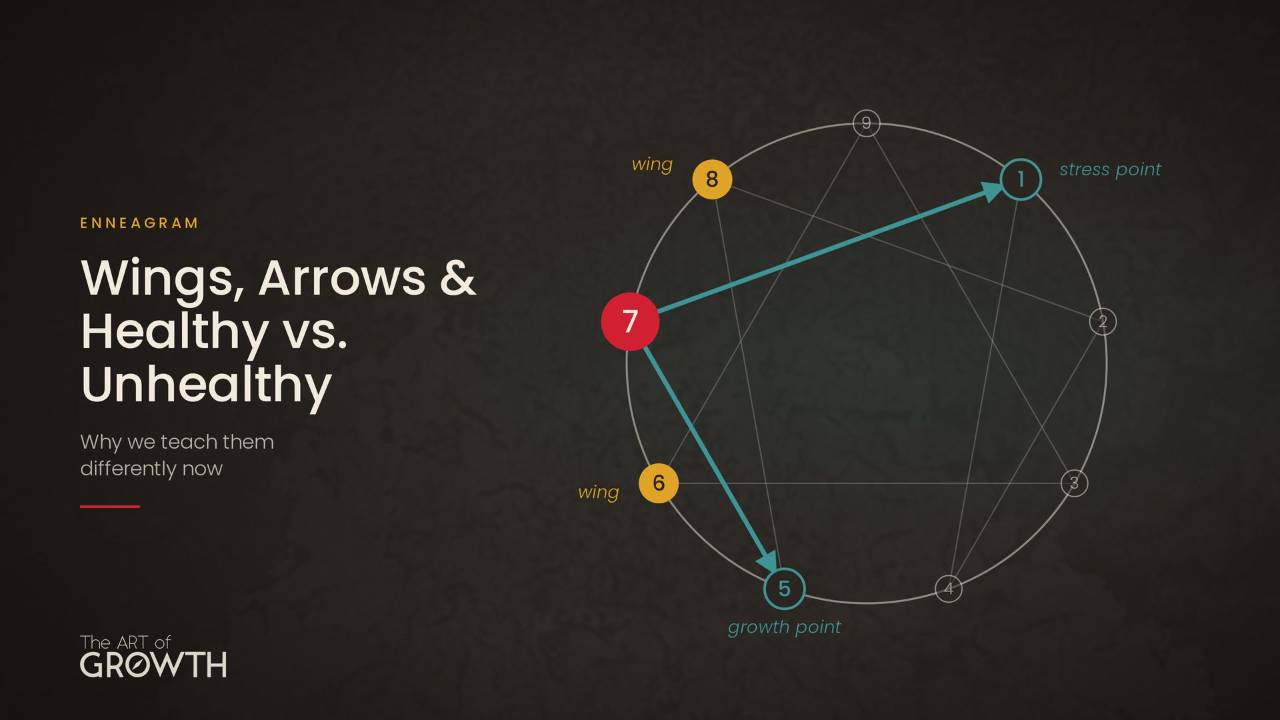
And Why We Teach Them Differently Now
If you learned the Enneagram more than a few years ago, you probably learned your wing. You were a 7 with an 8 wing, or a 4 with a 5 wing. It came with the package. You may also have learned that your type had a healthy version and an unhealthy version, and that two lines on the diagram told you where you go in stress and where you go in growth.
We don't teach any of those three in quite the same way anymore. That isn't because we think those models are bad or that the observations behind them aren't real. They have been helpful to a lot of people, and they were developed to make sense of patterns that are genuinely there. But as we've worked with thousands of people in typing interviews, panels, coaching, and training, we've kept asking the same question: what is most helpful for people to actually understand themselves and grow? More and more, that has led us toward the instincts.
This is what we've found most useful, and what we teach now.
What About Wings?
Wings are one way of explaining variety. Anyone who works with the Enneagram runs into the same thing early. Two people are both Type 7, and they don't look alike. One is louder and more forceful. The other is careful and plans ahead. Same core motivation, different person. It happens with two Type 4s, two Type 9s, any type you pick.
For a long time, one of the primary ways of explaining those differences was to look at the numbers on either side. The forceful 7 seemed to have some 8 qualities. The careful 7 seemed to have some 6 qualities. So we called them 7w8 and 7w6. It gave people language for something they could clearly see in themselves and each other, and many people still find that language helpful.
Wings weren't the only model developed to explain this variety. Tritype proposed that each of us has a type from each of the three centers. Other teachers and traditions have approached variation in different ways. They are all trying to answer an important question: if there are nine core types, why can people of the same type look so different?
The way we teach the Enneagram begins with one core type and one core motivation. A Type 7 is organized around pursuing what is positive and interesting while avoiding what feels limiting or painful. Whatever else is happening in that person's personality, we want to keep returning to that central motivation rather than adding more types to explain every behavioral difference.
That is one reason we don't use Tritype much in our teaching either. It may give people useful descriptive language, but we've found that we can usually get further by understanding the interaction between one core type and the instincts.
There is another limitation we've encountered with wings. Because wings are limited to the two adjacent numbers, they don't always account for the full range of ways people of the same type can appear. A careful, routine-loving 7 may resemble qualities we associate with Type 1 or Type 5, even though neither is a wing. A Type 6 may display characteristics at different times that resemble several other types. For us, that raised the question of whether something broader than adjacent numbers might be shaping those differences.
There is also a simpler explanation for some of what gets attributed to wings: people develop. A 7 who spends five years building a business may become far more disciplined and structured than they were before. Someone who becomes a parent, leads a team, experiences loss, or develops a new skill set may begin behaving in ways they didn't ten years earlier. The core motivation can remain the same while the person grows and changes around it.
So we don't think the observations behind wings are meaningless. Far from it. People are noticing real differences. We've simply found another framework that has been more helpful to us in explaining where many of those differences come from.
The Instincts Help Explain the Variety
The three instincts are self-preservation, one-to-one, and social. We call them Farmer, Hunter, and Teamer. Everyone has all three. One leads, another comes second, and the third gets the least automatic attention. That order is your instinct stack, and it shapes where your attention goes and what you reach for when you need to feel okay.
Each instinct is watching for something different. The Farmer watches for stability: resources, rhythms, and enough margin to feel safe. The Hunter watches for what is alive: the next pursuit, the person or project worth going all the way into. The Teamer watches for the group and its purpose: who is in it, what it is for, and where you fit.
Go back to the two Type 7s. The careful one who plans ahead, thinks about resources, and keeps enough structure in place so the fun can happen without wreckage may identify strongly with a 6 wing. Through the instincts, we might also understand that person as a Farmer-first Type 7. The caution and preparation can make a lot of sense when we see the self-preservation instinct shaping how Type 7 shows up.
The forceful 7 who goes after intensity, takes the risk, and doesn't mind being seen may identify strongly with an 8 wing. Through the instincts, we might see a Hunter-first Type 7. The core motivation is still Type 7, while the instinct helps explain where that 7 energy is most naturally directed.
What has made the instincts especially useful for us is that they stand on their own as a complete system. You can often recognize someone's stack without knowing their type, and it will tell you a lot about where their attention goes, what matters to them, and what drains them. The six possible instinct stacks combined with the nine Enneagram types give us 54 distinct combinations.
In our experience, that combination has consistently given us a practical and nuanced way of understanding people. That doesn't mean wings or Tritype have nothing to offer. We simply find ourselves reaching for the instincts first because they have proven more useful in the work we actually do with people.
What About Healthy Versus Unhealthy Types?
For a long time the Enneagram came with a ladder. Each type had a healthy version, an average version, and an unhealthy version, and you were somewhere on it. That gave people a picture of what growth and deterioration could look like, and there is something valuable about recognizing that the same type can express itself very differently depending on development.
What we've found more useful is talking about where someone is integrated or reactive rather than trying to place the whole person at one level. The same person can be steady and generous at work and reactive at home. Clear with a friend and defended with a parent. Disciplined with money and careless with their body. Human beings don't always develop evenly.
We also like that this language keeps us from turning healthy and unhealthy into a verdict about the person. You are at different places in your development in different areas of your life. What the Enneagram gives you is a way to notice those patterns and work with them, not a grade for how well you're doing your type.
So we talk about states more than levels. In some parts of your life you may be in a more integrated state. Your attention is open, all three centers are in the conversation, and you can respond instead of simply react. In other parts you may be in a more reactive state, where the familiar pattern of your type takes over before you have much choice in the matter. Neither one defines who you are. They describe what is happening in that area of your life right now.
Often the difference between the two is history. The area where you are integrated may be somewhere you have done significant work, been through something difficult, practiced intentionally, or had a good teacher. The area where you are reactive may simply be somewhere you haven't paid as much attention yet. That means it isn't fixed.
This changes the question. Instead of only asking how healthy a Type 4 you are, you can ask where in your life you are integrated and where you are reactive. We have found that question much more practical because it gives you something specific to notice and something specific to work on.
What About the Stress and Growth Arrows?
You may have learned that each type has two lines on the diagram. One points to where you go in stress. The other points to where you go in growth. Some teachers call them integration and disintegration. Those coming from spiritual direction may use language like consolation and desolation. Different traditions have used those lines to describe meaningful patterns in how people respond under pressure and how they develop.
We still use those connected numbers, but we tend to call them resource points, and we don't limit each one to a single direction. We've found it helpful to think of every resource point as having both integrated and reactive expressions.
Type 7 is connected to Type 1 and Type 5. Under pressure, one 7 may get rigid, critical, and controlling, drawing on the more reactive side of Type 1. Another may pull back, shut down, and retreat into their own head, drawing on the more reactive side of Type 5. At other times, either of those same points can be an incredible resource. The 7 can access the discipline and follow-through of Type 1 or the focus and depth of Type 5. In our work, we've watched people draw on either connected point in both stress and growth, and the instincts often help us understand why one resource feels more accessible than another.
We've also found it useful not to treat those two lines as the entirety of someone's growth path. Type 7 already lives in the Head Center. Type 5 gives the 7 another Head resource. Type 1 gives them a Body resource. If part of integration is gaining greater access to all three centers, that still leaves an important question: where does the 7 gain access to the Heart Center?
That is one reason we also use the harmonic triads as resource points. The Enneagram's harmonic groups form three sets of three: 3-6-9, 2-5-8, and 1-4-7. For a 7, that brings Type 4 into the conversation. Type 4 can offer the 7 a way into the heart: staying with sadness, longing, meaning, and the parts of experience that can't simply be reframed into something positive. In our experience, when a 7 moves more deeply into heart space, the resources of Type 4 often give us especially helpful language for what is happening.
And like the other resource points, Type 4 has reactive expressions too. A 7 can become caught in sadness, shame, loss, or the feeling that something important is missing. We aren't replacing one "good" destination with another. We are looking at a wider range of resources and asking how they are being accessed.
For five of the types, the two arrow points and the harmonic triad turn out to be the same numbers. Type 8 connects to 2 and 5 on the lines, and its triad is 2-5-8. Types 1, 3, 6, 8, and 9 work this way, so they have two resource points rather than three.
So we still find the traditional lines useful. We simply use them without assuming that one can only represent stress and the other growth, and we look beyond them when another center offers an important resource. The question becomes less "where does my type go in stress or growth?" and more "what resource do I need right now, and am I accessing its integrated side or its reactive side?"
What This Means If You Learned It Another Way
If you learned the Enneagram with wings, levels, and arrows, you didn't learn it wrong. Those frameworks have helped countless people notice meaningful things about themselves, and they continue to be useful to many teachers and students of the Enneagram. Our own teaching has changed because we've continued watching, listening, experimenting, and asking what seems to help people most.
If you know your wing and it has been useful to you, there is no reason to throw it out. We would simply invite you to look at your instincts alongside it. If you call yourself a 7w6 because you are careful, prepared, and want a safety net under the fun, what happens when you look at your self-preservation instinct? If you call yourself a 7w8 because you are intense and quick to go after what you want, what do you notice when you look at the Hunter instinct? Sometimes the instinct gives people another layer of explanation that feels surprisingly practical.
If you learned to think of yourself as a healthy or unhealthy version of your type, try making the question smaller. Where in your life are you integrated right now, and where are you reactive?
If you learned fixed stress and growth arrows, keep paying attention to those connected points, but notice both sides of each one. When do they become resources? When do they become reactive patterns? And what happens when you bring the other centers into the conversation?
The Enneagram has always developed through people paying closer attention to themselves and to one another. We don't think every older idea needs to be discarded whenever another model becomes useful. We are simply trying to keep asking the question that has guided our work from the beginning: what helps people understand themselves most clearly and actually do something with what they see? For us, the instincts have become one of the most useful answers to that question.